Same task and same data as 01_training_instance_segmentation.ipynb. There we trained a U-Net
from scratch. Here we start from Cellpose-SAM, which already is trained on a cell or nucleus looks like, and
only finetune it towards our nuclei-from-actin task. That usually needs far fewer images.
Run 01_training_instance_segmentation.ipynb up to the end of section 2 first (or
python organize_data.py): this notebook uses the same dataset/ split.
Kernel: the Cellpose kernel on Research Cloud, nlbi26-day3-cellpose on your own laptop.
from pathlib import Path

import numpy as np
import pandas as pd
import matplotlib.pyplot as plt
from skimage.io import imread

from cellpose import models, train, metrics, io

io.logger_setup()
creating new log file
[GUI INFO] : WRITING LOG OUTPUT TO /home/mpaul2/.cellpose/run.log
cellpose version: 4.2.1.1
platform: linux
python version: 3.11.15
torch version: 2.12.1+cu130
2026-09-17 23:21:17,409 [io INFO] WRITING LOG OUTPUT TO /home/mpaul2/.cellpose/run.log
2026-09-17 23:21:17,409 [io INFO]
cellpose version: 4.2.1.1
platform: linux
python version: 3.11.15
torch version: 2.12.1+cu130
(<Logger cellpose (DEBUG)>, PosixPath('/home/mpaul2/.cellpose/run.log'))DATASET = Path('dataset')
def load(split):
names = sorted(p.name for p in (DATASET / split / 'images').glob('*.tif'))
images = [imread(DATASET / split / 'images' / n) for n in names]
labels = [imread(DATASET / split / 'labels' / n) for n in names]
return names, images, labels
train_names, train_images, train_labels = load('train')
val_names, val_images, val_labels = load('val')
test_names, test_images, test_labels = load('test')
print(len(train_images), 'train,', len(val_images), 'val,', len(test_images), 'test')78 train, 20 test
1. Cellpose out of the box
Before fine-tuning, see what the pretrained model already does. Cellpose-SAM needs no
model_type, no channels and no diameter — it works those out itself.
pretrained = models.CellposeModel(gpu=True)

masks_before, _, _ = pretrained.eval(test_images, batch_size=8)

print('found', [m.max() for m in masks_before[:5]], '...')
print('labels', [l.max() for l in test_labels[:5]], '...')
2026-09-17 23:21:27,225 [core INFO] ** TORCH CUDA version installed and working. **
2026-09-17 23:21:27,226 [core INFO] >>>> using GPU (CUDA)
2026-09-17 23:21:27,227 [models INFO] Downloading: "https://huggingface.co/mouseland/cellpose-sam/resolve/main/cpsam_v2" to /home/mpaul2/.cellpose/models/cpsam_v2
100%|██████████| 1.15G/1.15G [00:14<00:00, 82.6MB/s]
2026-09-17 23:21:44,420 [models INFO] >>>> loading model /home/mpaul2/.cellpose/models/cpsam_v2
2026-09-17 23:21:44,987 [utils INFO] 0%|          | 0/20 [00:00<?, ?it/s]
/opt/AI_tools_pixi/cellpose/.pixi/envs/default/lib/python3.11/site-packages/cellpose/dynamics.py:541: UserWarning: Sparse invariant checks are implicitly disabled. Memory errors (e.g. SEGFAULT) will occur when operating on a sparse tensor which violates the invariants, but checks incur performance overhead. To silence this warning, explicitly opt in or out. See `torch.sparse.check_sparse_tensor_invariants.__doc__` for guidance.  (Triggered internally at /pytorch/aten/src/ATen/Context.cpp:760.)
  coo = torch.sparse_coo_tensor(pt, torch.ones(pt.shape[1], device=pt.device, dtype=torch.int),
2026-09-17 23:21:58,612 [utils INFO] 100%|##########| 20/20 [00:13<00:00,  1.47it/s]
found [np.uint16(135), np.uint16(138), np.uint16(122), np.uint16(4), np.uint16(35)] ...
labels [np.uint16(137), np.uint16(135), np.uint16(107), np.uint16(2), np.uint16(35)] ...
Score it. average_precision gives us TP, FP and FN per image at each IoU threshold, and
precision, recall and F1 follow from those three — the same numbers as in 01.
def score(masks, threshold=0.5):
    ap, tp, fp, fn = metrics.average_precision(test_labels, masks, threshold=[threshold])
    tp, fp, fn = tp[:, 0], fp[:, 0], fn[:, 0]

    # np.maximum(..., 1) only kicks in when a count is 0, and keeps the division safe
    precision = tp / np.maximum(tp + fp, 1)
    recall = tp / np.maximum(tp + fn, 1)
    f1 = 2 * tp / np.maximum(2 * tp + fp + fn, 1)

    return pd.Series({
        'TP': tp.mean(), 'FP': fp.mean(), 'FN': fn.mean(),
        'precision': precision.mean(), 'recall': recall.mean(), 'F1': f1.mean(),
    })

score(masks_before).round(2)
TP 2.300000
FP 103.000000
FN 95.199997
precision 0.020000
recall 0.020000
F1 0.020000
dtype: float322. Fine-tune it
One call. The settings below are the ones the Cellpose docs recommend for fine-tuning;
the only one we lowered is n_epochs, so it finishes inside the session.
Path('cellpose_output').mkdir(exist_ok=True)
model = models.CellposeModel(gpu=True)

model_path, train_losses, val_losses = train.train_seg(
    model.net,
    train_data=train_images,
    train_labels=train_labels,
    test_data=val_images,    # Cellpose calls it test, it is our validation set
    test_labels=val_labels,
    n_epochs=20,             # the docs suggest 100; 20 is enough to see the effect
    learning_rate=1e-5,
    weight_decay=0.1,
    batch_size=1,
    save_path='cellpose_output',
    model_name='nuclei_from_phalloidin',
)

print('saved to', model_path)
2026-09-17 23:22:57,115 [core INFO] ** TORCH CUDA version installed and working. **
2026-09-17 23:22:57,115 [core INFO] >>>> using GPU (CUDA)
2026-09-17 23:22:58,740 [models INFO] >>>> loading model /home/mpaul2/.cellpose/models/cpsam_v2
2026-09-17 23:22:59,112 [train INFO] >>> converting bfloat16 network to float32 for training
2026-09-17 23:22:59,118 [dynamics INFO] computing flows for labels
100%|██████████| 78/78 [00:02<00:00, 34.09it/s]2026-09-17 23:23:01,455 [dynamics INFO] computing flows for labels
100%|██████████| 20/20 [00:00<00:00, 36.85it/s]2026-09-17 23:23:02,011 [train INFO] >>> computing diameters
100%|██████████| 78/78 [00:00<00:00, 869.59it/s]
100%|██████████| 20/20 [00:00<00:00, 864.54it/s]
2026-09-17 23:23:02,127 [train INFO] >>> normalizing {'lowhigh': None, 'percentile': None, 'normalize': True, 'norm3D': True, 'sharpen_radius': 0, 'smooth_radius': 0, 'tile_norm_blocksize': 0, 'tile_norm_smooth3D': 1, 'invert': False}
2026-09-17 23:23:02,671 [train INFO] >>> n_epochs=20, n_train=78, n_test=20, bsize=256, batch_size=1, nimg_per_epoch=78
2026-09-17 23:23:02,671 [train INFO] >>> AdamW, learning_rate=0.00001, weight_decay=0.10000
2026-09-17 23:23:02,673 [train INFO] >>> saving model to cellpose_output/models/nuclei_from_phalloidin
2026-09-17 23:23:22,243 [train INFO] 0, train_loss=6.2226, test_loss=5.6097, LR=0.000000, time 19.57s
2026-09-17 23:24:53,307 [train INFO] 5, train_loss=1.1026, test_loss=0.3278, LR=0.000006, time 110.63s
2026-09-17 23:26:24,711 [train INFO] 10, train_loss=0.3824, test_loss=0.2842, LR=0.000010, time 202.04s
2026-09-17 23:29:07,513 [train INFO] saving network parameters to cellpose_output/models/nuclei_from_phalloidin
2026-09-17 23:29:11,670 [train INFO] >>> converting network back to torch.bfloat16 after training
saved to cellpose_output/models/nuclei_from_phalloidin
plt.plot(train_losses, label='train')
plt.plot(val_losses, label='validation')
plt.xlabel('epoch')
plt.ylabel('loss')
plt.legend()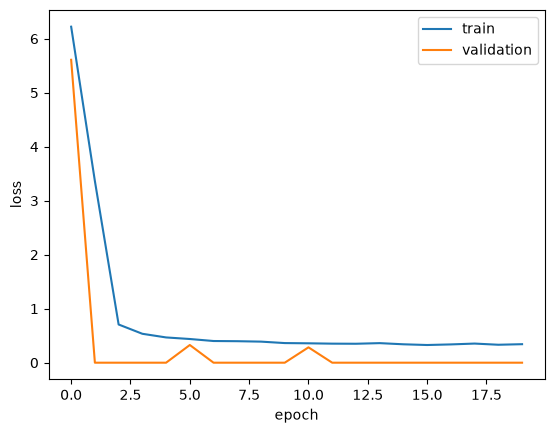
3. Score it again
finetuned = models.CellposeModel(gpu=True, pretrained_model=model_path)

masks_after, _, _ = finetuned.eval(test_images, batch_size=8)

pd.DataFrame({
    'pretrained': score(masks_before),
    'fine-tuned': score(masks_after),
}).round(2)
2026-09-17 23:29:11,816 [core INFO] ** TORCH CUDA version installed and working. **
2026-09-17 23:29:11,817 [core INFO] >>>> using GPU (CUDA)
2026-09-17 23:29:13,265 [models INFO] >>>> loading model cellpose_output/models/nuclei_from_phalloidin
2026-09-17 23:29:13,636 [utils INFO] 0%| | 0/20 [00:00<?, ?it/s]
2026-09-17 23:29:22,703 [utils INFO] 100%|##########| 20/20 [00:09<00:00, 2.21it/s]
i = 0   # change this to look at another test image

fig, axes = plt.subplots(1, 4, figsize=(20, 5))
axes[0].imshow(test_images[i], cmap='gray',
               vmin=np.percentile(test_images[i], 1), vmax=np.percentile(test_images[i], 99.8))
axes[0].set_title(test_names[i])

for ax, lab, title in zip(axes[1:],
                          [test_labels[i], masks_before[i], masks_after[i]],
                          ['labels', 'pretrained', 'fine-tuned']):
    ax.imshow(np.ma.masked_equal(lab, 0), cmap='tab20', interpolation='nearest')
    ax.set_title(f'{title}: {lab.max()} objects')

for ax in axes:
    ax.axis('off')
The pretrained model was never asked to find nuclei in an actin image. The fine-tuned one has seen our training images. Where does it still get it wrong?
If you have time
Try to train longer for
n_epochs=100Fine-tune on 10 images instead of all (
train_images[:10],train_labels[:10]). This is the argument for fine-tuning: how far down can you go before the score drops?